Friday, April 29, 2011

Record Commodities Prices and the Forex Markets

Propelled by economic recovery and the recent Mideast political turmoil, oil prices have firmly shaken off any lingering credit crisis weakness, and are headed towards a record high. Moreover, analysts are warning that due to certain fundamental changes to the global economy, prices will almost certainly remain high for the foreseeable future. The same goes for commodities. Whether directly or indirectly, the implications for forex market will be significant.
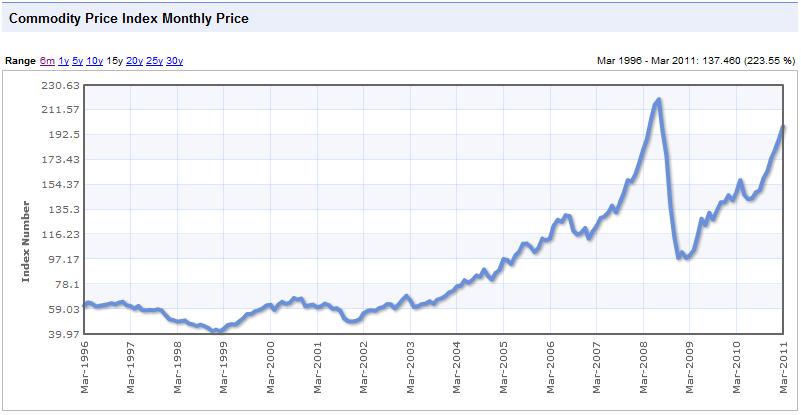

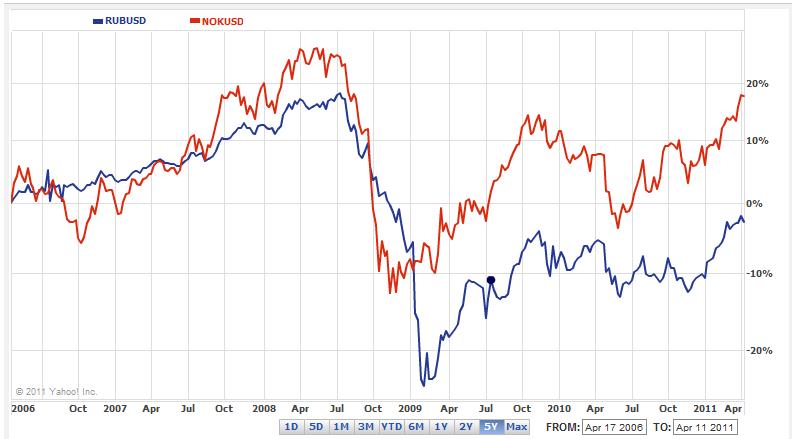
First of all, there is a direct impact on trade, and hence on the demand for particular currencies. Norway, Russia, Saudia Arabia, and a dozen other countries are witnessing record capital inflow expanding current account surpluses. If not for the fact that many of these countries peg their currencies to the Dollar and/or seem to suffer from myriad other issues, there currencies would almost surely appreciate. In fact, the Russian Rouble and Norwegian Krona have both begun to rise in recent months. On the other hand, Canada and Australia (and to a lesser extent, New Zealand) are experiencing rising trade deficits, which shows that their is not an automatic relationship between rising commodity prices and commodity currency strength.
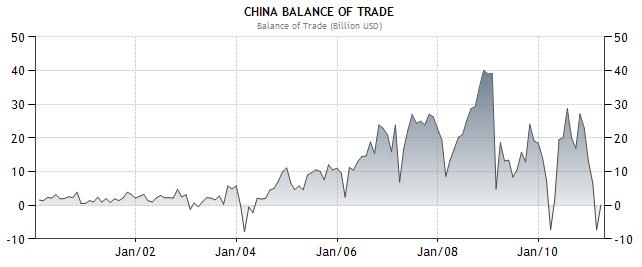
Those countries that are net energy importers could experience some weakness in their currencies, as trade balances move against them. In fact, China just recorded its first quarterly trade deficit in seven years. Instead of viewing this in terms of a shift in economic structure, economists need to understand that this is due in no small part to rising raw materials prices. Either way, the People’s Bank of China (PBOC) will probably tighten control over the appreciation of the Chinese Yuan. Meanwhile, the nuclear crisis in Japan is almost certainly going to decrease interest in nuclear power, especially in the short-term. This will cause oil and natural gas prices to rise even further, and magnify the impact on global trade imbalances.
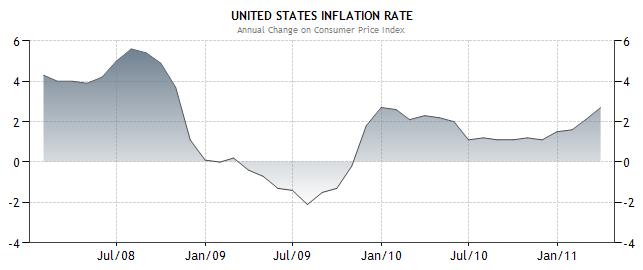
A bigger issue is whether rising commodities prices will spur inflation. With the notable exception of the Fed, all of the world’s Central Banks have now voiced concerns over energy prices. The European Central Bank (ECB), has gone so far as to preemptively raise its benchmark interest rate, even though Eurozone inflation is still quite low. In light of his spectacular failure to anticipate the housing crisis, Fed Chairman Ben Bernanke is being careful not to offer unambiguous views on the impact of high oil prices. Thus, he has warned that it could translate into decreased GDP growth and higher prices for consumers, but he has stopped short of labeling it a serious threat.

On the one hand, the US economy is undergone some significant structural changes since the last energy crisis, which could mitigate the impact of sustained high prices. “The energy intensity of the U.S. economy — that is, the energy required to produce $1 of GDP — has fallen by 50% since then as manufacturing has moved overseas or become more efficient. Also, the price of natural gas today has stayed low; in the past, oil and gas moved in tandem. And finally, ‘we’re closer to alternative sources of energy for our transportation,’ ” summarized Wharton Finance Professor Jeremy Siegal. From this standpoint, it’s understandable that every $10 increase in the price of oil causes GDP to drop by only .25%.

On the other hand, we’re not talking about a $10 increase in the price of oil, but rather a $50 or even $100 spike. In addition, while industry is not sensitive to high commodity prices, American consumers certainly are. From automobile gasoline to home eating oil to agricultural staples (you know things are bad when thieves are targeting produce!), commodities still represent a big portion of consumer spending. Thus, each 1 cent increase in the price of gas sucks $1 Billion from the economy. “If gas prices increased to $4.50 per gallon for more than two months, it would ‘pose a serious strain on households and could put the entire recovery in jeopardy. Once you get above $5, [there is] probably above a 50% chance that the economy could face a downturn.’ ”

Even if stagflation can be avoided, some degree of inflation seems inevitable. In fact, US CPI is now 2.7%, the highest level in 18 months and rising. It is similarly 2.7% in the Eurozone and Australia, where both Central Banks have started to become more aggressive about tightening monetary policy. In the end, no country will be spared from inflation if commodity prices remain high; the only difference will be one of extent.
Over the near-term, much depends on what happens in the Middle East, since an abatement in political tensions would cause energy prices to ease. Over the medium-term, the focus will be on Central Banks, to see if/how they deal with rising inflation. Will they raise interest rates and withdraw liquidity, or will they wait to act for fear of inhibiting economic recovery? Over the long-term, the pivotal issue is whether economies (especially China) can become less energy intensive or more diversified in their energy consumption.

At the moment, most economies are dangerously exposed, with China and the US topping the list. Russia, Norway, Brazil and a select few others will earn a net benefit from a boom in prices, while most others (notably Australia and Canada) are somewhere in the middle.

Another Basic Yet Effective Reason To Get Into The Market Is Waiting Pertaining To The Currencies To Produce A Pullback.

It is absolutely no mystery in which unexpected economy data is essential for rate to move up and down in the market.

Whilst youve to study skillset, the excellent news is Foreign currency trading is basic. Along with automated Forex currency trading, you may invest in exclusive Foreign currency trading computer software and insert the item straight into the personal computer. Therefore it is essential to get ready and be informed before trying your fortune in allowing income with the currency market. All the reasoning regarding action buying is simple.

Numerous untrained brokers also feel that profits are easily gleamed on any timeframe, perhaps right down to the 1 min time frame, with very little financial risk.

Markets may be generating huge movements on an intra-day stage but this does not suggest that you should be deliberately looking to buck typically the page tendency.

If you can find out a fabulous tutorial that features trading on the internet or computerized forex trading, then you may want to get that one as well, because almost all of the trading today are carried out on the web.

Furthermore you might want to think about what transacting program is provided. Actually, it is possible to come across large amounts of application in which you can utilize these days to assist you with currency trading. Web-based fx trading enjoys the greatest cash-flow in the world and dealings are value a lot more than many stock markets of the world together.

Currency trading which is also known as forex trading was not open for minor traders until not long ago. A word of warning, profits with your trial account does not ensure profits with funds when investing using the web.

You need a investing plan, yet wed like a thing that sparks your admittance into the forex exchange. This kind of trading has numerous benefits all over equity stock trading like the stock market. Its fees are extremely minimal, making the expense to a trader very small as well. It really is essential to select the right Forex trading service right from the beginning. An additional straightforward yet effective reason to get into the market is waiting with respect to price to create a pullback. Whenever a buy.sell appears great, the software program will then perform the trade for you personally determined by conditions you tested before making all of the software package to complete the job.

Foreign Exchange Risk Management

Foreign exchange can prove to be very profitable if you trade wisely. Listed below are a few perks of forex trading:

  • Very high leverage rates.
  • In-congruent liquidity.
  • Online trading is very convenient.

The Art of Risk Management

Learning the art of managing the risks plays a vital role in forex trading. A considerably high level of reluctance is often observed among individuals when it comes to forex trading. However, regardless of its nature, trade and risk go side by side, hence the need for risk management.

Risk Management in Forex Trading

Risk Prevention

To prevent any avertable risks, it is highly advisable to avoid scam dealers. Everything should be kept legal and transparent with the forex agent regarding the investment proposals and procedures. As mentioned earlier, forex trading comes with a handful of risks. Say, for instance, you are offered a leverage of 250:1 by a forex broker. In such a situation, you need to be fully aware of when the broker is actually making you profitable and when he is not being facilitative to your trade.

Forex agents might often show perseverance over higher leverage values, as it suits their interest. However, for you, although high leverage might prove to be profitable, but there is an equal risk of loss as well. Therefore, vigilance and risk management can rid you of such trading.

Being in control of your risk, since right the beginning, puts you in a better place, where you can use the leverage sensibly to make the best out of the investment. Therefore, while choosing a forex agent, you should only commit the amount that is needed for the trade, or what you can afford to lose. However, it requires adequate risk management.

Risk Management for Maximization of Profits

The foreign exchange market is unpredictable. Forex rates may fluctuate during the moment you place the deal and when you go for liquidating it. This will have a toll on the forex price contract and eventually the prospective profit or loss pertaining to it.

Risk Management for Maximization of Profits

You should arrange your risk management profile in such a way that it limits the forex agent from taking risks which you cannot afford. This way you can prevent the risk of losing the capital of your investment.

Risk management in the forex market involves another method, known as diversification. More entry signals can be generated by trading one currency pair. Diversification of trade between different currencies is advisable, if you intend to lower the risk in the forex market. You should try trading several pairs of currency at the same time.

Polish Your Skills for Better profit

Trading with a bit too high margin should be avoided. Forex trading is not different than any other form of trade. Therefore, it is strictly advised to observe, practice, learn, and polish your skills before you put them to test. Resources like e-books, papers, the internet, video courses, and seminars should be relied on. You should test your skills on the demo account that is provided for free.

When you’re in the forex market, the key to risk management is knowledge. Self education is the best thing you can do before stepping into trade. How chart indicators are to be read? How the analysis data is to be read? What is the driving force of the currency price movement? Operational and counter-party risks are minimized by instantaneous settlements.

Forex Markets Focus on Central Banks

Over the last year and increasingly over the last few months, Central Banks around the world have taken center stage in currency markets. First, came the ignition of the currency war and the consequent volley of forex interventions. Then came the prospect of monetary tightening and the unwinding of quantitative easing measures. As if that wasn’t enough to keep them busy, Central Banks have been forced to assume more prominent roles in regulating financial markets and drafting economic policy. With so much to do, perhaps it’s no wonder that Jean-Claude Trichet, head of the ECB, will leave his post at the end of this year!


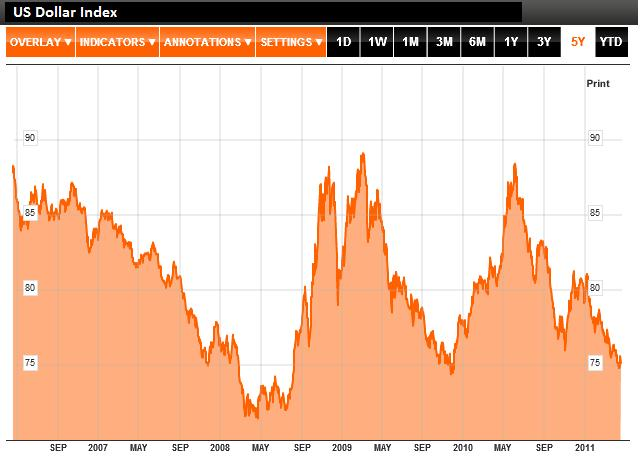
The currency wars may have subsided, but they haven’t ended. On both a paired and trade-weighted basis, the Dollar is declining rapidly. As a result, emerging market Central Banks are still doing everything they can to protect their respective currencies from rapid appreciation. As I’ve written in earlier posts, most Latin American and Asian Central Banks have already announced targeted strategies, and many intervene in forex markets on a daily basis. If the Japanese Yen continues to appreciate, you can bet the Bank of Japan (perhaps aided by the G7) will quickly jump back in.

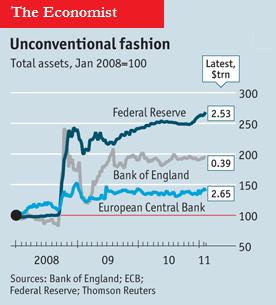
You can expect the currency wars to continue until the quantitative easing programs instituted by the G4 are withdrawn. The Fed’s $600 Billion Treasury bond buying program officially ends in June, at which point its balance sheet will near $3 Trillion. The European Central Bank has injected an equally large hunk of cash into the Eurozone economy. Despite inflation that may soon exceed 5%, the Bank of England voted not to sell its cache of QE assets, while the Bank of Japan is actually ratcheting up its program as a result of the earthquake-induced catastrophe. Whether or not this manifests itself in higher inflation, investors have signaled their distaste by bidding up the price of gold to a new record high.


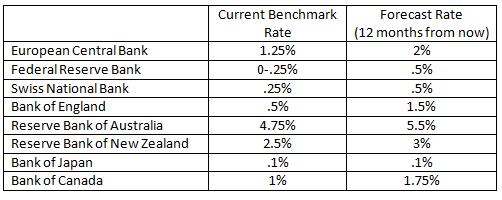
Then there are the prospective rate hikes, cascading across the world. Last week, the European Central Bank became the first in the G4 to hike rates (though market rates have hardly budged). The Reserve Bank of Australia, however, was the first of the majors to hike rates. Since October 2009, it has raised its benchmark by 175 basis points; its 4.75% cash rate is easily the highest in the industrialized world. The Bank of Canada started hiking in June 2010, but has kept its benchmark on hold at 1% since September. The Reserve Bank of New Zealand lowered its benchmark to a record low 2.5% as a result of serious earthquakes and economic weakness.

Going forward, expectations are for all Central Banks to continue (or begin) hiking rates at a gradual pace over the next couple years. If forecasts prove to be accurate, the US Federal Funds Rate will stand around .5% at the beginning of 2012, tied with Switzerland, and ahead of only Japan. The UK Rate will stand slightly above 1%, while the Eurozone and Canadian benchmarks will be closer to 2%. The RBA cash rate should exceed 5%. Rates in emerging markets will probably be even higher, as all four BRIC countries (Russia, Brazil, China, India) should be well into the tightening cycles.


On the one hand, there is reason to believe that the pace of rate hikes will be slower than expected. Economic growth remains tepid across the industrialized world, and Central Banks are wary about spooking their economies with premature rate hikes. Besides, Fed watchers may have learned a lesson as a result of a brief bout of over-excitement in 2010 that ultimately led to nothing. The Economist has reported that, “Markets habitually assign too much weight to the hawks, however. The real power at the Fed rests with its leaders…At present they are sanguine about inflation and worried about unemployment, which means a rate rise this year is unlikely.” Even the ECB disappointed traders by (deliberately) adopting a soft stance in the press release that accompanied its recent rate hike.

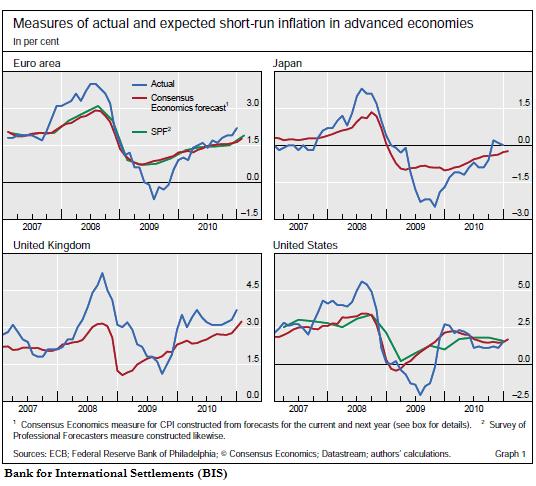
On the other hand, a recent paper published by the Bank for International Settlements (BIS) showed that the markets’ track record of forecasting inflation is weak. As you can see from the chart below, they tend to reflect the general trend in inflation, but underestimate when the direction changes suddenly. (This is perhaps similar to the “fat-tail” problem, whereby extreme aberrations in asset price returns are poorly accounted for in financial models). If you apply this to the current economic environment, it suggests that inflation will probably be much higher-than-expected, and Central Banks will be forced to compensate by hiking rates a faster pace.
Finally, in their newfound roles as economic policymakers, Central Banks are increasingly engaged in macroprudential policy. The Economist reports that, “Central banks and regulators in emerging economies have already imposed a host of measures to cool property prices and capital inflows.” These measures are worth watching because their chief aim is to indirectly reduce inflation. If they are successful, it will limit the need for interest rate hikes and reduce upward pressure on their currencies.

In short, given the enhanced ability of Central Banks to dictate exchange rates, traders with long-term outlooks may need to adjust their strategies accordingly. That means not only knowing who is expected to raise interest rates – as well as when and by how much – but also monitoring the use of their other tools, such as balance sheet expansion, efforts to cool asset price bubbles, and deliberate manipulation of exchange rates.

Automatic Forex Trading Systems

Automatic forex trading system welcomes many forex traders to make surplus passive income without monitoring the forex market trends constantly. There are three basic ways by which automatic forex trading can be done.
Advantages of Automatic Forex Trading System

Automatic forex trading system is a great tool for forex traders who cannot keep themselves updated with the latest forex market trends on regular basis.

Advantages of Automatic Forex Trading System

This is because this great tool helps them to generate a good amount of money without keeping eyes on the changing market trends. Another great advantage of automatic forex trading system is that it allows traders to take part in the buying and selling process of the forex market. To do so, traders don’t have to study the market trends or learn the timings and process of doing trades. This easiness is due to the involvement of a robot, an expert forex trading advisor, and a forex account manager. The forex account manager will operate the trades of the trader.
Automatic Forex Trading Via Trading Robot

A trading robot is of great help in the automatic forex trading system. It can be programmed to carry out trades by the application of historical price changes within the program algorithm of this robot. It might sound like an ideal method of generating real profits similar to the previous trades. However, one should not forget that price history is not a reliable source to trade profitably. This particularly because the conditions of the actual forex trade market like wider spreads and unfilled data are required to be incorporated in the forex analysis. These are used to get reliable results for the prediction of the upcoming market conditions from which a forex trader can generate real profits. A forex trading robot cannot perform this action. This is because its algorithm does not contain idea about future predictions.
Downside of Trading Robots

Critics argue that trading robots are really expensive and are cost-prohibitive for beginner forex traders. Due to the high cost of trading robots, new traders cannot make use of these robots, as they cannot afford to have a forex trading robot.

In addition to this, a forex trading robot cannot guarantee the real profits every time from its trades. Therefore, investment in such a robot can be highly risky for any investor and especially for small investors.
Account Managers for Automatic Forex Trading

Account Managers for Automatic Forex Trading

Automatic forex trading can also be carried out via account managers. These managers have got the required experience and skills that are essential to work in the forex market for a trader and for trades which these traders are willing to do. The downside of forex account manager is that they can be really costly. Due to this limitation, small investors or traders having stringent funds cannot hire these managers.
Third-Party Service Providers

Automatic forex trading can also be done via third-party service providers that include forex investors and forex signal. Forex investors will pick and choose from an extensive variety of forex signal providers that are offering trade signals on the basis of the different kinds of forex trading strategies. These signal providers will offer useful trading signals on the basis of the market analysis and trading strategy that is used the investor.

After that the trade signal will be entering automatically as a trade order for traders who select to use that particular trading signal. This entire process is automated and suitable for traders who are willing to work with automatic forex trading.

Time to Short the Euro

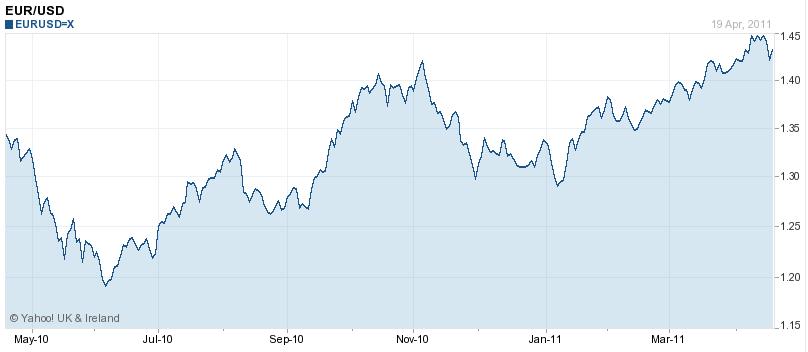
Over the last three months, the Euro has appreciated 10% against the Dollar and by smaller margins against a handful of other currencies. Over the last twelve months, that figure is closer to 20%. That’s in spite of anemic Eurozone GDP growth, serious fiscal issues, the increasing likelihood of one or more sovereign debt defaults, and a current account deficit to boot. In short, I think it might be time to short the Euro.


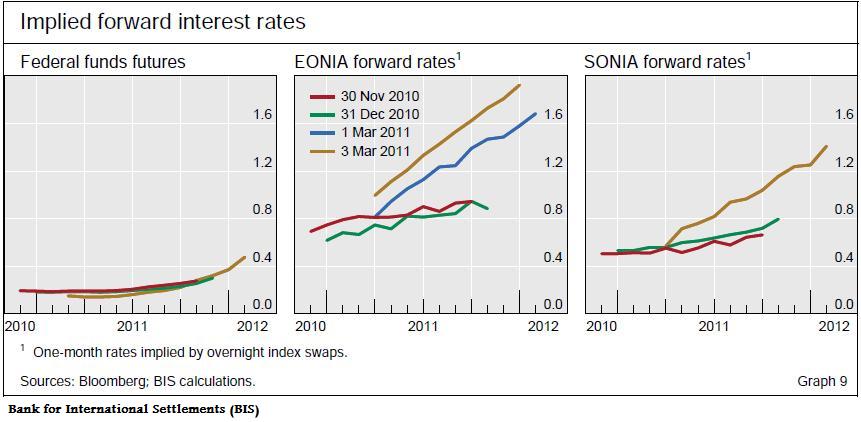
There’s very little mystery as to why the Euro is appreciating. In two words: interest rates. Last week, the European Central Bank (ECB) became the first G4 Central Bank to hike its benchmark interest rate. Moreover, it’s expected to raise rates by an additional 100 basis points over the next twelve months. Given that the Bank of England, Bank of Japan, and US Federal Reserve Bank have yet to unwind their respective quantitative easing programs, it’s no wonder that futures markets have priced in a healthy interest rate advantage into the Euro well into 2012.


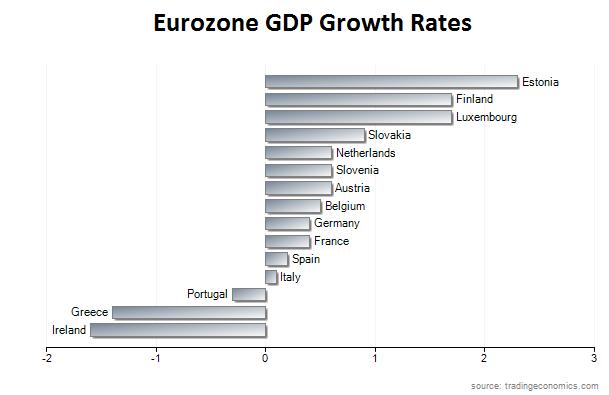
From where I’m sitting, the ECB rate hike was fundamentally illogical, and perhaps even counterproductive. Granted, the ECB was created to ensure price stability, and its mandate is less nuanced than its counterparts, which are charged also with facilitating employment and GDP growth. Even from this perspective, however, it looks like the ECB jumped the gun. Inflation in the EU is a moderate 2.7%, which is among the lowest in the world. Other Central Banks have taken note of rising inflation, but only the ECB feels compelled enough to preemptively address it. In addition, GDP growth is a paltry .3% across the EU, and is in fact negative in Greece, Ireland, and Portugal. As if the rate hike wasn’t bad enough, all three countries must contend with a hike in their already stratospheric borrowing costs, ironically making default more likely. Talk about not seeing the forest for the trees!

If the rumors are true, Portugal will soon become the third country to receive a bailout from the EU. (It should be noted that as recently as November, Portugal insisted that it was just fine and that a bailout wasn’t necessary). Its sovereign credit rating is now three notches above junk status. Today, Greece became the first Eurozone country to be awarded this dubious distinction, and Ireland is now only one downgrade away from suffering the same fate. Of course, Spain insists that it is just fine and denies the possibility of a bailout. At this point, though, does it have any credibility? Based on rising credit default swap rates (which serve as a gauge of the probability of default), I think that investors have become a little more cynical about taking governments at face value.

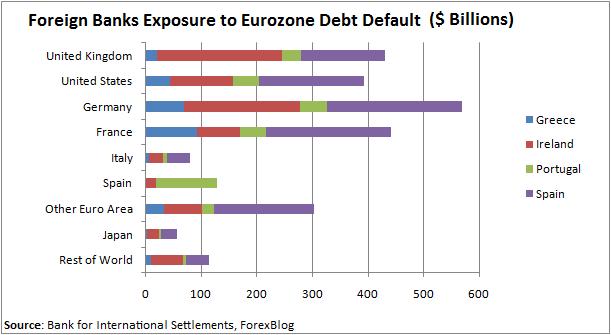
I have discussed the fiscal woes of the Eurozone in previous posts, and don’t want to dwell on them here. For now, I’d only like to add a footnote on the extent to which their problems are intertwined. Banks in Germany and France (as well as the rest of the EU) have tremendous balance sheet exposure to PIGS’ sovereign debt, which means that any default would multiply across the Eurozone in the form of bank failures. (You can see from the chart below that the exposure of the US is small, relative to GDP).

Some analysts insist that all of this has already been priced into the Euro. Citigroup Said, “The market is treating many of these [sovereign credit rating] downgrades as rearguard actions which are already well discounted.” Personally, I don’t think that forex markets have made a sincere effort to grapple with the possibility of default, which appears increasingly inevitable. In fact, when S&P issued a warning on the US AAA rating, traders responded by handing the Euro its worst intraday decline in 2011.

Any way you cut it, I think the Euro is overvalued. Regardless of what the ECB is doing, market interest rates don’t really confer much benefit to those holding Euros. Even if the rate differential widens to 1-2% over the next year (which is certainly not guaranteed, as Jean-Claude Trichet himself has conceded!) this isn’t really enough to compensate for the possibility of default or other risk event. Regardless of whether you want to be long or short risk, there isn’t much to be gained at the moment from holding the Euro.

Technical Indicators for Day Trading

Forex Technical Indicators of day trading are the gadgets applied by the traders to formulate a forecast for different aspects entailed in daily trading. If one makes right use of these technical indicators, these may demonstrate quite fruitful results.
Technical Indicators Helps in Making Forecasts

technical indicators in forex market

A technical indicator may help in making predictions about the future drift in the specific currency pair. These indicators also guide you regarding when to go in and go out of the trades. If one makes utilization of these indicators in right manner, then these can bring a great deal of profit.
Moving Averages is the Frequently Used Indicator

Moving Averages is the Forex Day Trading Indicator that investors utilize on frequent basis. The other admired gauges comprise of Pivot Points, MCAD, Bollinger Bands, etc.
Myth of Using Indicators

Majority of Forex traders believe that if they just download these indicators and make use of these automatically in their trading activities will guarantee to bring them profit. This thought is nothing more than an allegory. You must recognize that it is not only the use of these indicators for producing buying and selling hints or identifying the go in and go out tips that bring you the profit, but there are certain other things to take care of.

For instance the indicators of moving averages illustrate the track of market drift. The most frequently used moving averages in this regard are 21 days, 35 days, 50 days, 100 days and 200 days. However, you must keep in mind that their legitimacy is based merely on day to day charts. As per the experienced professionals in this field, an indication can be treated as superior when the 13days moving average crosses the 50 days moving average.

Once this situation arises, one should make trading towards the path of the cross. The dilemma exists here is that such type of crosses do not happen frequently, so that traders may take advantage of these. This can even direct to the state of affairs in which traders want to turn around this cross.

This state may also compel you to pursue with an endeavor to forecast a cross. These all situations are desirable, if you want to keep track of the existing market.
Other Issues Associated with Forex Day Trading Technical Indicators

Forex Day Trading Technical Indicators

The other dilemmas in this regard are the matters related to the quotations and the rates that you have offered to your broker. Forex brokers are market leaders and the various brokers offer you various quotations and rates at a particular time. A distinct rate can point out to a condition in which the number of traders is trading in the same market, but the identical signs offer various reactions to them.
Indicators were Developed Long Time Back

You must also keep in mind that these indicators were build-up in the absence of real time details couple of years back. Hence, you are required to work out the restrictions allied to these day trading technical indicators. Besides that, you must comprehend the fact that technical analysis is just one segment of your trading tactic. You therefore, cannot base your decision entirely on these.

A current study has unearthed the fact that only 26% of the total number of traders makes utilization of technical analysis and signals in comparison to 41% of traders who apply fundamental analysis for their purpose. Hence, your trading must be supported with the research and investigation of the market as well as other factors besides day trading technical indicators.


People who liked this Post also read

* Another Free Forex Analysis Software Tool
Instead of spending all the time, knowledge or inclination on several tables and huge information, now Forex analysis software can be used. Use of such software is easy and time saving....
* Euro Dollar Present & Future
The recession and financial crisis of 2008 left its footprints stamped on even the best of economies. The euro dollar suffered in the shape of its countries getting hampered by traumatic affects one by one, while the US dollar suffered the sting of it and...
* What a Beginner Should Do In Forex Trading?
Forex market is a highly volatile market that is complicated for beginner forex traders. Beginners can attain stable success in this field by working with useful strategies and skills. They have to be consistent and work hard to achieve firm position in f...
* Best Timing For Forex Trading
The influence of forex markets in the world is increasing on the daily basis. Forex market offers you to trade 24 hours a day and around a week. The key to increase your profit level is to select the best time for trading....
* What Are the Best Times to Trade the US Dollar?
The US is the world's second biggest forex trading center. The best time to trade the USD is when the US session is in progress. You have to take care of certain things while trading in the US session whether you are working on long or short term basis....